FIELD NOTES
The Enterprise Guide to AI Governance: Platforms, Frameworks, and Selection
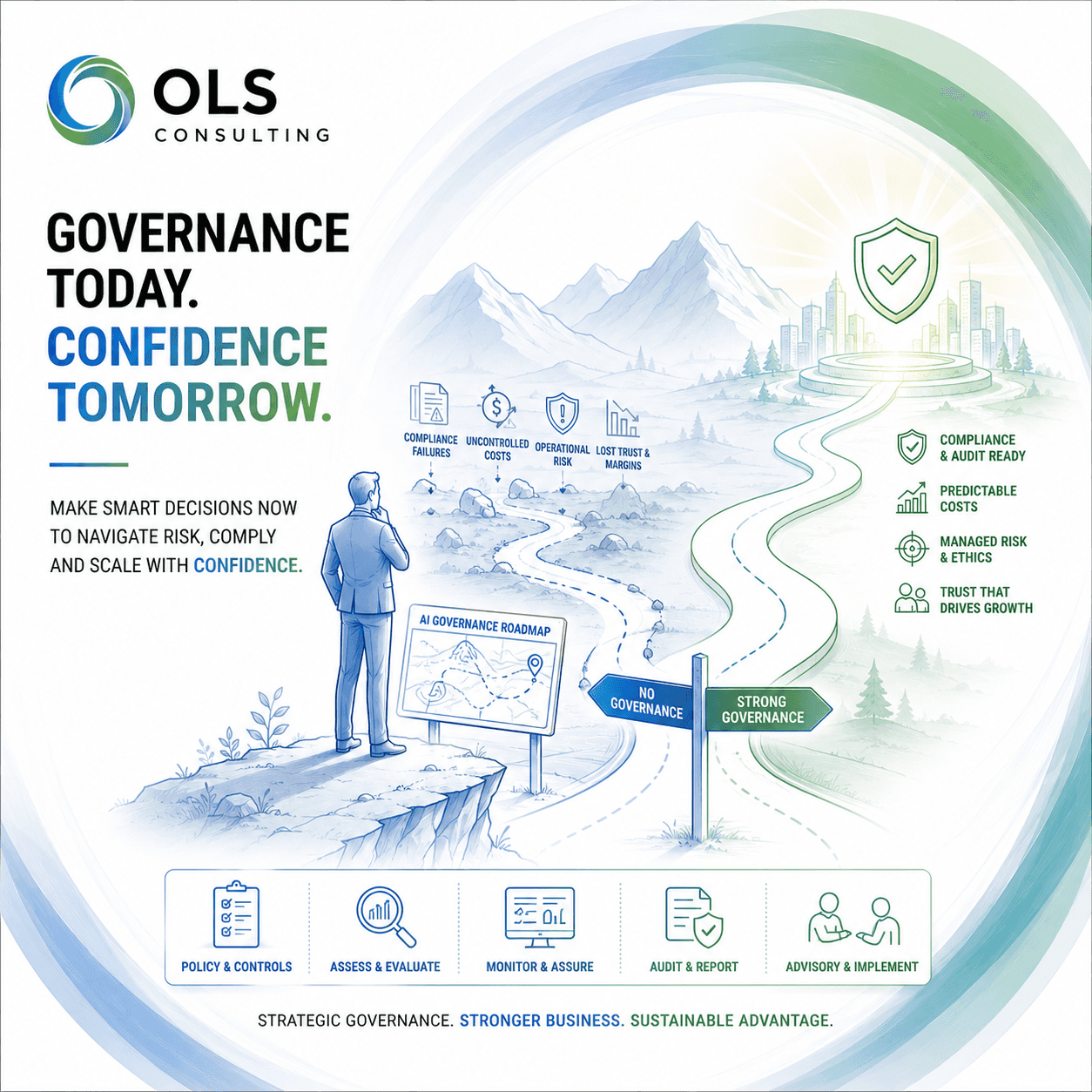
AI governance is the operational layer that decides whether AI initiatives protect margins or compound risk - sprawl, compliance gaps, decisions nobody can trace back.
7 MIN READ
Recent IAPP research confirms the shift: 77% of organizations are actively building governance programs, rising to near 90% among those already running AI in production. Just as telling: 30% of organizations that haven't yet deployed AI in production are already building governance ahead of it. Retrofitting governance after models are live is more expensive and more error-prone than building it first.
Here's the practical guide I use when advising leadership teams on platforms, frameworks, risk management, and ethics structures.
What AI Governance Actually Is
AI governance is the set of policies, processes, and technical controls that keep AI systems in service of business objectives, regulatory requirements, risk tolerance, and ethical standards.
It matters because unregulated AI quickly creates new forms of Cognitive Debt and Shadow IT. Unmonitored agents drive unpredictable token costs. Opaque decision logic creates audit and liability exposure. Organizations that treat governance as foundational, not administrative, move faster - because their architecture can defend itself when someone asks hard questions.
The Governance Vendor Landscape Is Fragmented by Design
If you're expecting a single "all-in-one" platform to solve enterprise AI risk out of the box, you'll be disappointed. The ecosystem splits across four distinct functional layers. IAPP’s 2026 Vendor Report segments the market this way:
Policy and Compliance (GRC & Policy Layers): Platforms like OneTrust, Securiti.ai, and Collibra that manage system inventories, regulatory mapping, and workflow approvals.
Technical Assessments and Evaluations: Tooling like Credo AI, Fiddler AI, and Arthur AI focused on model testing, bias detection, performance monitoring, and security scanning.
Assurance and Auditing: Independent frameworks and audit services (major firms, or specialists like Holistic AI) that validate compliance against standards.
Consulting and Advisory: Human-led practices bridging the gap between static policy and runtime infrastructure.
Enterprises rarely rely on a single vendor. Mature stacks combine a GRC system of record with technical evaluation pipelines, backed by advisory oversight to prevent integration debt.
Where Platforms Actually Differ on Compliance
Direct vendor comparisons depend heavily on your industry vertical and existing tech stack, but clear tiers emerge on compliance capability:
Regulatory Mapping & Workflows: Platforms built out of traditional data privacy and GRC roots excel at documentation, audit trails, and multi-framework mapping (EU AI Act, GDPR, ISO/IEC 42001).
Model-Centric Observability: Platforms originating from MLOps excel at runtime monitoring, drift detection, and automated testing — but often lack deep legal-compliance mapping.
The Pitfall: The most common failure mode is tool sprawl — an expensive model-testing tool your compliance team never logs into, or a policy tool your engineers bypass entirely. A governance-first diagnostic has to precede software procurement, not follow it.
Five Criteria That Actually Matter in Vendor Selection
When evaluating software in the Technical Assessments and Policy categories, cut through the marketing noise with five mandatory checks:
Risk Taxonomy Alignment: Does the tool map to your specific threat model: prompt injection, hallucination bounds, model drift, third-party supply chain vulnerabilities?
Integration Surface: Can it hook into your existing CI/CD pipelines, MLOps tooling, and identity management without custom engineering?
Evidence and Audit Readiness: Does it generate immutable audit trails that satisfy external supervisors, rather than unstructured log files?
Cost and Scale Transparency: How does it handle token overhead, compute drag, and alert fatigue for engineering teams?
Translation Capability: Does it bridge the gap between legal policy language and technical execution?
That last one: the translation gap - is the single biggest operational pain point out there. Most organizations still struggle to map legislative requirements to actual technical controls, and most vendor selections fail in practice because they ignore this layer entirely.
How I Advise Technology Firms to Choose
Start with an architectural assessment of your AI usage and platform maturity:
Establish a governance-first intake process that captures decision rationale before models hit staging.
Build a minimal viable governance stack — don't add tools that compound technical and cognitive debt.
Tie vendor selection directly to your actual risk profile, compliance mandates, and deployment topology (SaaS vs. private VPC).
I run these exact current-state assessments as part of Enterprise Platform Blueprint engagements - mapping liabilities and structuring tool requirements before capital is committed.
Standing Up an AI Ethics Board That Works
For smaller and growth-stage companies, heavy enterprise frameworks will stall execution. Start with lightweight decision records, clear acceptable-use guardrails, and automated review gates tied directly to existing engineering workflows.
For larger organizations building an AI Ethics Board:
Grant Real Authority: Charter the board with cross-functional representation (legal, engineering, product, risk) and a direct reporting line to executive leadership. Don't treat it as an advisory sideline.
Operationalize Over Aspiration: Focus on concrete mechanisms — model review checklists, red-teaming protocols, runtime monitoring — not generic ethical manifestos.
Embed, Don't Duplicate: Integrate review gates into existing product release cycles instead of creating parallel administrative overhead.
Where My Advisory Work Fits
Enterprises rarely suffer from a lack of policies; they suffer from an inability to operationalize them. Bridging the gap between high-level regulatory frameworks and production architecture takes hands-on operating experience.
That's the core of my Fractional Executive Advisory practice: designing pragmatic AI governance architectures, rationalizing vendor stacks, and installing risk-management harnesses that close the translation gap without choking velocity.
The Operator’s Bottom Line
AI governance done right prevents the compounding of technical, cognitive, and compliance debt. Done poorly, it's an expensive exercise that slows everything down.
The 77% of organizations building programs are right to move. The 30% doing it governance-first are ahead of them. Most still need help turning regulatory text and crowded vendor lists into platform architecture that survives real-world pressure.
If your AI initiatives are outpacing your ability to govern them safely, the Enterprise Platform Blueprint is the diagnostic starting point. For ongoing execution, my Fractional Executive Advisory covers fractional leadership.